
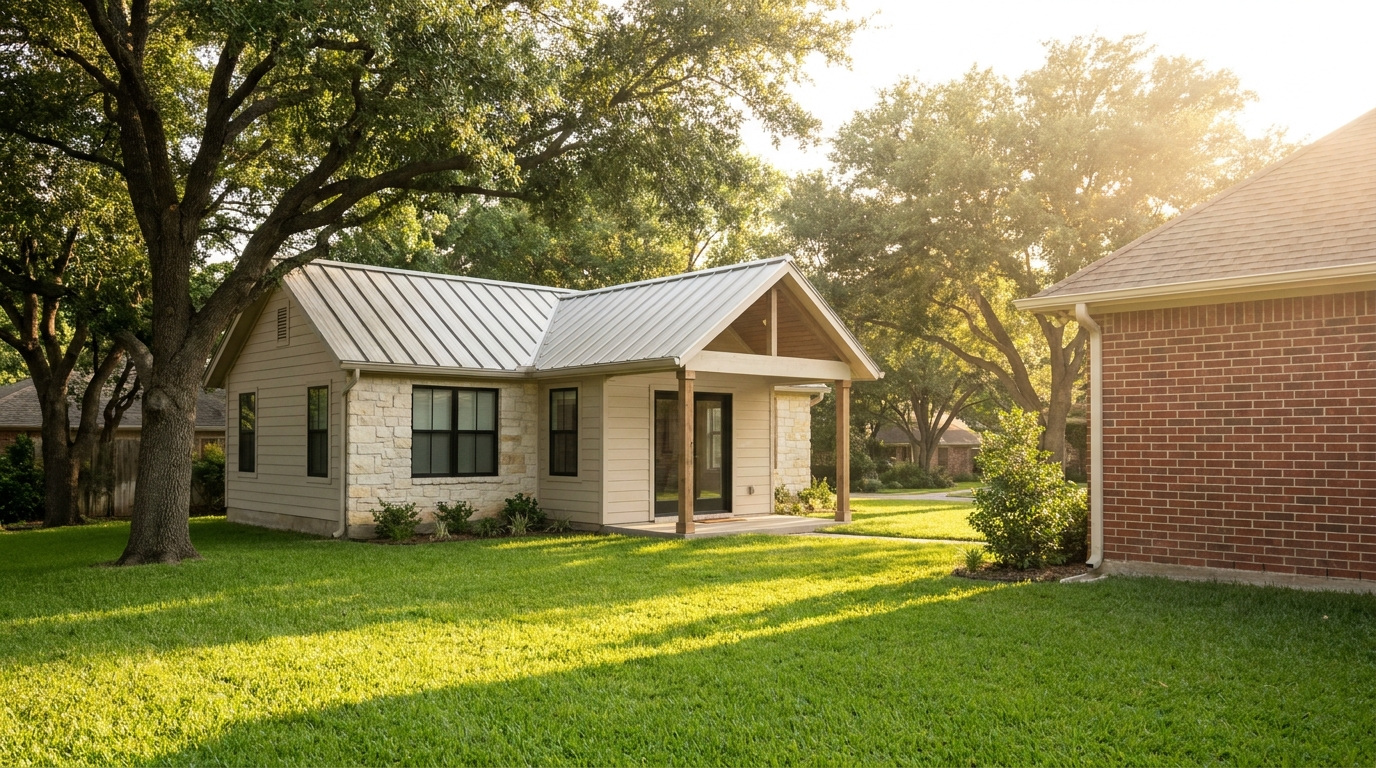
An ADU (accessory dwelling unit) in Dallas is a second, self-contained home on a single-family lot, with its own kitchen, bathroom, and private entrance. Families use them as mother-in-law suites, spaces for adult children, guest houses, or rental units. In 2026, a Dallas ADU usually costs $65,000 to $150,000 when you convert an existing garage or interior space, and $150,000 to $230,000 or more for a detached new build, roughly $130 to $300 per square foot. Dallas caps most ADUs near 700 to 800 square feet, expects the owner to live on the property, and does not permit them by right in every single-family neighborhood. Many lots need an Accessory Dwelling Unit Overlay (ADUO) or a Board of Adjustment special exception before the city will issue a building permit. A mother-in-law suite is the same thing described by who lives there rather than by code: an ADU set up for a relative.
ADU vs. Mother-in-Law Suite: What Is the Difference?
People use these terms interchangeably, and for a homeowner the difference rarely matters much. The distinction is about code versus everyday language.
An accessory dwelling unit is a legal category. To count as an ADU, the space needs its own kitchen (or full kitchenette), a bathroom, a sleeping area, and independent access. That combination is what lets it function as a complete second household. A mother-in-law suite, sometimes called a granny flat or in-law suite, just describes the use. Most mother-in-law suites are ADUs. Some are not, because they skip the full kitchen and share the main home’s entry, which keeps them as a bedroom suite rather than a separate unit.
Why it matters in Dallas: if a space has a full second kitchen and a private door, the city treats it as an ADU, and ADU zoning rules apply. If you keep it as a bedroom, sitting room, and bathroom that open into the main house, it is usually treated as a standard room addition and follows simpler rules. That single decision, full kitchen or not, changes your permit path, your budget, and sometimes whether you can build at all on your lot.
Types of ADUs and What Each One Costs in Dallas
There are four common ways to add an ADU or in-law suite to a Dallas home. They differ a lot in price, disruption, and how much square footage you gain. Here is how they compare in 2026.
| ADU type | Typical Dallas cost (2026) | Cost per sq ft | Best for |
|---|---|---|---|
| Garage conversion (attached) | $25,000 to $75,000 basic; $65,000 to $135,000 for a full suite | $100 to $200 | Fastest, lowest-cost path; keeps the home’s footprint |
| Interior or bonus-room conversion | $30,000 to $100,000 | $80 to $160 | Homes with unused space over a garage or a large bonus room |
| Attached addition (bump-out suite) | $80,000 to $200,000 | $200 to $350 | Families who want the suite connected to the main house |
| Detached new build (backyard cottage) | $150,000 to $230,000+ | $130 to $300 | Maximum privacy, rental potential, and resale flexibility |
A garage conversion is where most Dallas homeowners start, because the slab, walls, and roof already exist. The catch is that Dallas often requires you to replace the parking you remove, so budget for a carport or driveway pad. A detached backyard unit costs the most because it needs its own foundation, its own utility connections, and a separate roof, but it gives you a true standalone home that appraisers and buyers treat as a distinct asset.

Dallas ADU Cost Breakdown: Where the Money Goes
Two ADUs of the same size can differ by $50,000 depending on how far utilities have to travel and how finished the space needs to be. This breakdown is for a detached 600-square-foot backyard unit, the most involved of the four types. Conversions cost less because several of these line items already exist.
| Cost category | Share of budget | Notes for Dallas homeowners |
|---|---|---|
| Foundation and slab | 10 to 15 percent | North Texas expansive clay soil often calls for a stronger slab and moisture detailing |
| Framing, roof, and exterior | 20 to 25 percent | Fiber cement siding such as James Hardie holds up well to Texas sun and hail |
| Plumbing and utility runs | 12 to 18 percent | Longer runs from the main house to a backyard unit raise the cost |
| Electrical and HVAC | 12 to 16 percent | A right-sized mini-split handles Dallas summers efficiently in a small unit |
| Kitchen and bath fixtures | 12 to 18 percent | Kohler, Moen, and Delta fixtures are common mid-range choices |
| Interior finishes and flooring | 10 to 15 percent | Luxury vinyl plank is popular for durability and easy cleaning |
| Permits, design, and engineering | 6 to 10 percent | Includes the ADUO or zoning step, plan review, and required inspections |
If those percentages look familiar, it is because an ADU is a small house. The same cost drivers that shape a room addition or a second-story addition apply here, just at a smaller scale with the added complexity of a full second kitchen.
Dallas ADU Rules and Zoning in 2026
This is the part that surprises people. Dallas does not allow an ADU on every single-family lot automatically. The city’s development code permits ADUs in several residential districts, but in many neighborhoods you first need an Accessory Dwelling Unit Overlay (ADUO) approved for that area, or a special exception from the Board of Adjustment. Before you fall in love with a floor plan, the first job is confirming what your specific lot allows.
Here are the standards that typically apply once an ADU is allowed on your property. Treat these as a starting point and verify against your zoning district, because the numbers shift by district and get updated over time.
| Rule | Typical Dallas standard |
|---|---|
| Where ADUs are allowed | Certain single-family and townhouse districts, often only with an ADUO overlay or a Board of Adjustment special exception |
| Maximum size | Commonly capped around 700 to 800 square feet, and generally no larger than the main house |
| Setbacks | Must meet rear and side yard setbacks for the district; detached units keep a set distance from the property line |
| Owner occupancy | The owner is expected to live in the main house or the ADU |
| Parking | Usually one additional off-street space; may be reduced near DART rail |
| Utilities | Often served from the main house rather than a separate meter |
| Short-term rental | Restricted in many residential areas; check current Dallas short-term rental rules before counting on Airbnb income |
The single most useful thing you can do early is call the Dallas Department of Sustainable Development and Construction, or have your contractor do it, and ask two questions: is an ADU allowed on this lot under current zoning, and if not, what is the overlay or exception process. That one phone call can save months. Suburbs handle this differently. If you are in Plano, Frisco, McKinney, or Allen, each city has its own accessory-unit rules and some are more restrictive than Dallas, so the answer for your street may look nothing like your cousin’s across the county line.
Permits and the Build Process, Step by Step
An ADU touches zoning, structural, electrical, plumbing, and mechanical review, so it carries more paperwork than a kitchen or bathroom project. Here is the usual order of events for a Dallas ADU.
- Zoning check. Confirm the lot allows an ADU, or start the ADUO overlay or Board of Adjustment process. This is the gate everything else waits behind.
- Design and engineering. Produce site plans, floor plans, and structural details. Backyard units on North Texas clay usually need a stamped foundation design.
- Permit submittal. File for the building permit with all trade sub-permits. Dallas permit fees for an ADU commonly run $2,200 to $3,800.
- Plan review. The city reviews for code compliance. Expect a few weeks, longer if corrections are requested.
- Construction. Foundation, framing, rough-ins, insulation, drywall, finishes. A detached unit typically takes four to seven months on site.
- Inspections and certificate of occupancy. The unit passes staged inspections, then a final sign-off that makes it legal to occupy.
| ADU type | Design and permitting | Construction | Total realistic timeline |
|---|---|---|---|
| Garage conversion | 3 to 8 weeks | 6 to 12 weeks | 3 to 5 months |
| Interior conversion | 3 to 8 weeks | 6 to 14 weeks | 3 to 6 months |
| Attached addition | 6 to 12 weeks | 3 to 5 months | 5 to 8 months |
| Detached new build | 2 to 4 months (longer with an overlay) | 4 to 7 months | 7 to 12 months |
Skipping the permit is a bad idea with an ADU specifically. An unpermitted second kitchen shows up during a future sale, can hold up the closing, and may force expensive after-the-fact corrections. It also complicates insurance if something goes wrong. The same principle we cover in our guide to kitchen remodel permits in Dallas applies with more force here, because you are creating a whole dwelling.
Designing a Mother-in-Law Suite for an Aging Parent
Most Dallas families build these suites for a parent, and that changes the design brief. You are planning a space someone will use for years as their needs shift. A few decisions now prevent a second renovation later.
- Single-level access. No steps at the entry. A zero-step threshold and a gently sloped walkway matter more than any finish.
- Wider doorways and halls. Aim for 36-inch doors and 42-inch halls so a walker or wheelchair fits without a fight.
- A curbless shower. A curbless walk-in shower with a bench and grab bars is the single most valuable safety feature in the suite.
- Lever handles and rocker switches. Easier on hands that have lost grip strength.
- Good lighting. Layered, bright, and easy to reach, with night lighting on the path to the bathroom.
This overlaps heavily with our aging-in-place remodel guidance and our home accessibility work. If the parent already uses a wheelchair, the bathroom deserves special attention, and our wheelchair-accessible bathroom guide covers the roll-in shower and clearance details in depth. Building these features in from day one costs a fraction of retrofitting them after a fall.
How to Pay for a Dallas ADU
An ADU is a large enough project that most homeowners finance it rather than pay cash. The right option depends on how much equity you hold and whether the unit will earn rent.
| Financing option | How it works | Good fit when |
|---|---|---|
| Home equity loan or HELOC | Borrow against existing equity, often at a lower rate than unsecured debt | You have owned the home a while and built equity |
| Cash-out refinance | Replace your mortgage with a larger one and take the difference | Current rates are at or below your existing rate |
| Renovation loan (FHA 203k or Fannie Mae HomeStyle) | Rolls the project cost into the mortgage based on after-completion value | You lack equity but the finished ADU adds clear value |
| Construction loan | Draws released in stages as the build progresses | Ground-up detached units |
If the plan is a rental ADU, some lenders will count projected rent toward what you qualify for, which changes the math. Run the numbers with a lender before you finalize a budget. Deciding between adding this space and simply buying a bigger home is its own question, and our remodel vs. move comparison walks through the commissions and closing costs that often make staying put the cheaper path.
Does an ADU Add Value in Dallas?
Usually yes, though not dollar for dollar on build cost. Homes with a legal, permitted ADU tend to sell for more and draw a wider pool of buyers: multigenerational families, house hackers who want rental income, and buyers who simply value a private guest space. National data puts the value bump anywhere from 15 to 35 percent depending on the market and build quality, and a well-run rental unit can bring in $1,200 to $2,200 a month in the Dallas area.
Two honest caveats. First, an ADU rarely returns 100 percent of its cost at resale on its own, so the strongest case is usually the combination of use value now (housing a parent, avoiding assisted-living fees, or collecting rent) plus a resale premium later. Second, the unit has to be permitted to count. An unpermitted suite can actually complicate a sale. For a fuller look at how additions pencil out here, see our analysis of whether home additions increase property value in Dallas.
Common Mistakes Dallas Homeowners Make With ADUs
- Designing before checking zoning. The lot’s zoning decides what is possible. Start there, not with Pinterest.
- Forgetting replacement parking. Converting the garage often means you owe the city a replacement parking space.
- Undersizing utilities. A second kitchen and bath add real load. Skimping on the panel or water line causes problems later.
- Ignoring the parent’s five-year needs. Build accessibility in now while the walls are open.
- Hiring on price alone. An ADU is a full dwelling. Vet the contractor the way you would for a whole house, using the checks in our guide to choosing a remodeling contractor.
Building an ADU With ALC Construction Pros
ALC Construction Pros has remodeled homes across Dallas-Fort Worth since 2014, and we handle ADUs and in-law suites as full projects: the zoning legwork, design, permitting, and the build. We are based in Plano with a second office serving Dallas, and we work throughout the metroplex. If you are weighing a garage conversion against a detached unit, or you are not sure whether your lot even allows an ADU, we can find out and give you a realistic budget before you commit.
Take a look at our room additions and extensions and whole-home remodeling services, browse recent completed projects, or request a free consultation to talk through your ADU plans. We usually respond within the hour.
Frequently Asked Questions About ADUs in Dallas
Are ADUs legal in Dallas?
Yes, ADUs are legal in Dallas, but not automatically on every lot. The city allows them in certain residential districts, and many single-family properties need an Accessory Dwelling Unit Overlay or a Board of Adjustment special exception first. Confirm your specific lot with the Dallas Department of Sustainable Development and Construction before designing.
How much does an ADU cost in Dallas?
In 2026, a Dallas ADU runs $65,000 to $150,000 for a garage or interior conversion and $150,000 to $230,000 or more for a detached new build, roughly $130 to $300 per square foot. A basic garage conversion without a full kitchen can start near $25,000.
What is the maximum size of an ADU in Dallas?
Dallas commonly caps ADUs around 700 to 800 square feet, and the unit generally cannot be larger than the main house. The exact limit depends on your zoning district, so verify before finalizing a floor plan.
Is a mother-in-law suite the same as an ADU?
Mostly. A mother-in-law suite describes the use, housing a relative. If it has a full kitchen, a bathroom, and a private entrance, it is an ADU under the code. If it shares the main home’s kitchen and entry, it is usually treated as a bedroom suite or room addition instead.
Do I need a permit to build an ADU in Dallas?
Yes. An ADU needs a building permit plus electrical, plumbing, and mechanical sub-permits, and often a zoning approval first. Dallas permit fees for an ADU commonly total $2,200 to $3,800. An unpermitted unit can derail a future home sale.
How long does it take to build an ADU?
A garage conversion takes about three to five months start to finish. A detached backyard unit takes seven to twelve months, and longer if your lot needs an ADUO overlay, which adds two to four months for the rezoning step.
Can I rent out my ADU in Dallas?
Long-term rental is often allowed once the unit is permitted and the owner lives on the property. Short-term rental such as Airbnb is restricted in many residential areas, so check current Dallas short-term rental rules before you count on that income.
Does Dallas require owner occupancy for an ADU?
In most cases the owner must live in either the main house or the ADU. This rule is a common condition for approval, so factor it in if your long-term plan is to move away and rent both units.
What is the cheapest way to add a mother-in-law suite?
Converting an existing attached garage is usually the cheapest path because the foundation, walls, and roof already exist. Expect $25,000 to $75,000 for a basic suite, more if you add a full kitchen and upgrade utilities.
Is an attached or detached ADU better?
Attached units and garage conversions cost 10 to 20 percent less because they share the main home’s structure and utilities. Detached units cost more but give more privacy, stronger rental appeal, and clearer resale value as a standalone dwelling.
Do ADUs increase property taxes?
Usually yes. Adding permitted living space raises your home’s appraised value, which can raise your property tax. The added value and any rental income typically outweigh the tax increase, but ask your county appraisal district how they treat ADUs.
Can a garage conversion be a legal ADU?
Yes, if it meets the code: its own kitchen, bathroom, sleeping area, and independent entrance, plus any required replacement parking. A permitted garage-conversion ADU is legal to occupy and counts as living space at resale.
Do I need extra parking for an ADU in Dallas?
Usually one additional off-street parking space, and if you convert a garage you often owe a replacement space for the parking you removed. Parking requirements may be reduced for lots near DART rail stations.
What is the ROI on an ADU in Dallas?
An ADU rarely returns 100 percent of its build cost at resale on its own. The strongest return comes from combining use value now, such as housing a parent or collecting $1,200 to $2,200 a month in rent, with a resale premium of roughly 15 to 35 percent later.
Can I build an ADU in the Dallas suburbs?
Sometimes, but each suburb sets its own rules. Plano, Frisco, McKinney, and Allen each regulate accessory units differently, and some are stricter than Dallas. Always confirm with the specific city, not just Dallas County norms.
How big should a mother-in-law suite be?
Most comfortable one-person suites run 400 to 700 square feet: a bedroom, a full bath, a small living area, and a kitchenette. That size fits Dallas ADU caps and gives a parent real independence without wasted space.
Can an ADU share utilities with the main house?
Yes, and in Dallas ADUs are often served from the main house rather than getting a separate meter. Shared utilities lower the build cost. If you plan to rent and bill separately, ask your contractor about sub-metering.
What foundation does a detached ADU need in North Texas?
North Texas expansive clay soil moves with moisture, so a detached ADU usually needs an engineered slab with proper moisture detailing. This is one reason a stamped foundation design is worth the money on backyard units.
Will an ADU help with multigenerational living?
That is one of the most common reasons Dallas families build them. An ADU lets a parent or adult child keep independence and privacy while staying close, and it can cost far less over time than assisted living or a separate rental.
What is an ADUO in Dallas?
ADUO stands for Accessory Dwelling Unit Overlay. It is a zoning designation Dallas applies to a neighborhood or area to allow ADUs where they are not otherwise permitted by right. If your lot lacks the overlay, the overlay or a special exception is often the path to approval.
Can I put a kitchen in a mother-in-law suite?
Yes, and adding a full kitchen is what turns a bedroom suite into a true ADU. Just know that the full kitchen triggers ADU zoning rules, so confirm your lot allows an ADU before you plan one.
Is it cheaper to build an ADU or add on to the house?
Converting existing space, such as a garage or bonus room, is the cheapest option. A connected addition costs more but less than a fully detached unit, which carries its own foundation, roof, and utility runs. Your lot and goals decide which makes sense.
Who should I hire to build an ADU in Dallas?
Use a licensed, insured general contractor with real experience on additions and ground-up small structures, not just cosmetic remodels. Because an ADU is a complete dwelling, vet the contractor the way you would for a whole-house project and get everything in a detailed written contract.
Related Reading and Services
- How Much Does a Garage Conversion Cost in Dallas?
- Second-Story Addition Cost in Dallas
- Home Addition Cost in McKinney, Texas
- Do Home Additions Increase Property Value in Dallas?
- Aging in Place Remodel: A Dallas Homeowner’s Guide
Explore our services for room additions, home accessibility, kitchen remodeling, and bathroom remodeling, or see where we work across the Dallas-Fort Worth service area.




