

The most common ways to finance a home addition or full remodel in Texas in 2026 are a home equity loan or HELOC at roughly 7 to 8 percent interest, a cash-out refinance at about 7.1 to 7.6 percent, or a renovation loan such as an FHA 203(k) or Fannie Mae HomeStyle that lets you borrow against your home’s value after the work is finished. Most Dallas-Fort Worth homeowners fund large projects, a $60,000 to $110,000 room addition for example, with home equity, and use savings or a personal loan for work under $20,000. The right choice depends on how much equity you hold, the rate on your current mortgage, your credit score, the size of the project, and a Texas constitutional rule that caps all borrowing against your home at 80 percent of its value.
Home Remodel Financing Rates and Limits in August 2026
- HELOC: 7.16 to 7.50 percent average variable rate, draw funds as the project progresses
- Home equity loan: 7.35 to 8.10 percent average fixed rate, single lump sum
- Cash-out refinance: roughly 7.1 to 7.6 percent (30-year refinance averages 6.85 to 7.09 percent, plus a 0.25 to 0.5 point cash-out premium)
- Personal loan: 8 to 36 percent APR, most approved borrowers land between 12 and 15 percent, no collateral required
- FHA 203(k) Limited: up to $75,000 in renovation costs rolled into an FHA mortgage
- Texas Veterans Land Board home improvement loan: up to $50,000 fixed, 10 or 20 year terms
- Texas equity cap: every lien against your homestead combined cannot exceed 80 percent of its fair market value
Main Ways to Finance a Remodel or Addition in Texas
- Home equity loan: a fixed-rate second lien paid out as one lump sum, repaid over 5 to 30 years.
- HELOC: a revolving credit line against your equity with a draw period, usually 10 years, where you borrow only what you need.
- Cash-out refinance: replaces your existing mortgage with a larger one and hands you the difference in cash.
- Renovation loan: FHA 203(k), Fannie Mae HomeStyle, or Freddie Mac CHOICERenovation, all underwritten on the home’s projected value after the remodel.
- Construction loan: short-term financing for major additions, converted or refinanced into a mortgage when the build is complete.
- Personal loan: unsecured borrowing based on your credit alone, funded in days.
- Contractor financing: loans arranged through a remodeler’s lending partner, sometimes with promotional terms.
- Texas note: any loan that pulls cash out of your homestead falls under Section 50(a)(6) of the Texas Constitution, which adds the 80 percent cap, a 12-day waiting period, and a 2 percent cap on most lender fees.
Exact rates and loan amounts vary with every home, credit file, and lender, so treat the figures above as the market range rather than a quote. Before you pick a loan, have a qualified contractor assess the house, the scope, and your goals, because the loan should be sized from a real bid, not a guess. And be careful about signing up for financing offered through a salesperson’s tablet at your kitchen table: compare any contractor-arranged loan against at least two outside offers, the same way you would compare the contractors themselves.
Key Takeaways
- Home equity products are the workhorse for DFW remodels in 2026: HELOCs average 7.16 to 7.50 percent and fixed home equity loans 7.35 to 8.10 percent as of August 2026.
- Texas caps all borrowing against your homestead at 80 percent of its value, so a $400,000 home with a $280,000 mortgage supports at most $40,000 in new equity borrowing.
- If your current mortgage rate is under about 5 percent, a cash-out refinance usually costs you more in extra interest on the old balance than it saves, so a second-lien product protects that rate.
- Renovation loans (FHA 203(k), HomeStyle, CHOICERenovation) qualify you on the after-remodel value, which is the main workaround when equity is thin.
- Texas law imposes a 12-day minimum wait between application and closing on any home equity loan, plus a 3-day cancellation right after closing, so plan on 30 to 45 days before funds arrive.
- Texas veterans can borrow up to $50,000 for home improvements through the Veterans Land Board at fixed rates, with a rate discount for a VA disability rating of 30 percent or more.
- Size the loan from a firm bid plus a 10 to 15 percent contingency, not from a ballpark you found online.
Start With the Number, Not the Loan
Loan shopping goes wrong when it starts with the loan. Homeowners pick a product, borrow a round number, then find out the real bid runs 20 percent higher. Do it in the other order: define the scope, get real bids, then match a loan to the total.
What Common DFW Projects Cost in 2026
These ranges come from projects across Dallas, Plano, Frisco, McKinney, and Fort Worth. Every one of them links to a full cost guide if you want the line items.
| Project | Typical DFW cost (2026) | Cost guide |
|---|---|---|
| Mid-range kitchen remodel | $30,000 to $75,000 | Kitchen remodel cost in Dallas |
| Mid-range bathroom remodel | $15,000 to $30,000 | Bathroom remodel cost in Dallas |
| Room addition (about 400 sq ft) | $60,000 to $110,000 | Room addition cost in Dallas |
| Garage conversion | $15,000 to $35,000 basic, $65,000 to $150,000 full suite | Garage conversion cost in Dallas |
| ADU or backyard unit | $65,000 to $230,000+ | ADUs in Dallas |
| Second-story addition | $150,000 to $550,000 | Second-story addition cost |
| Whole-home renovation | $200,000 to $400,000+ | Whole home remodeling |
Add a Contingency Before You Borrow
Remodeling an existing house always carries surprises. Slab plumbing that has shifted, aluminum wiring behind a wall, rotten sill plates under a window that looked fine. Borrow the bid amount plus 10 to 15 percent. Fannie Mae requires a 10 percent contingency reserve on its HomeStyle renovation loans for a reason: projects that run over budget and out of money are how half-finished additions end up on the market. A HELOC handles this well because the cushion costs nothing unless you actually draw it.
Texas Home Equity Rules You Cannot Get Around
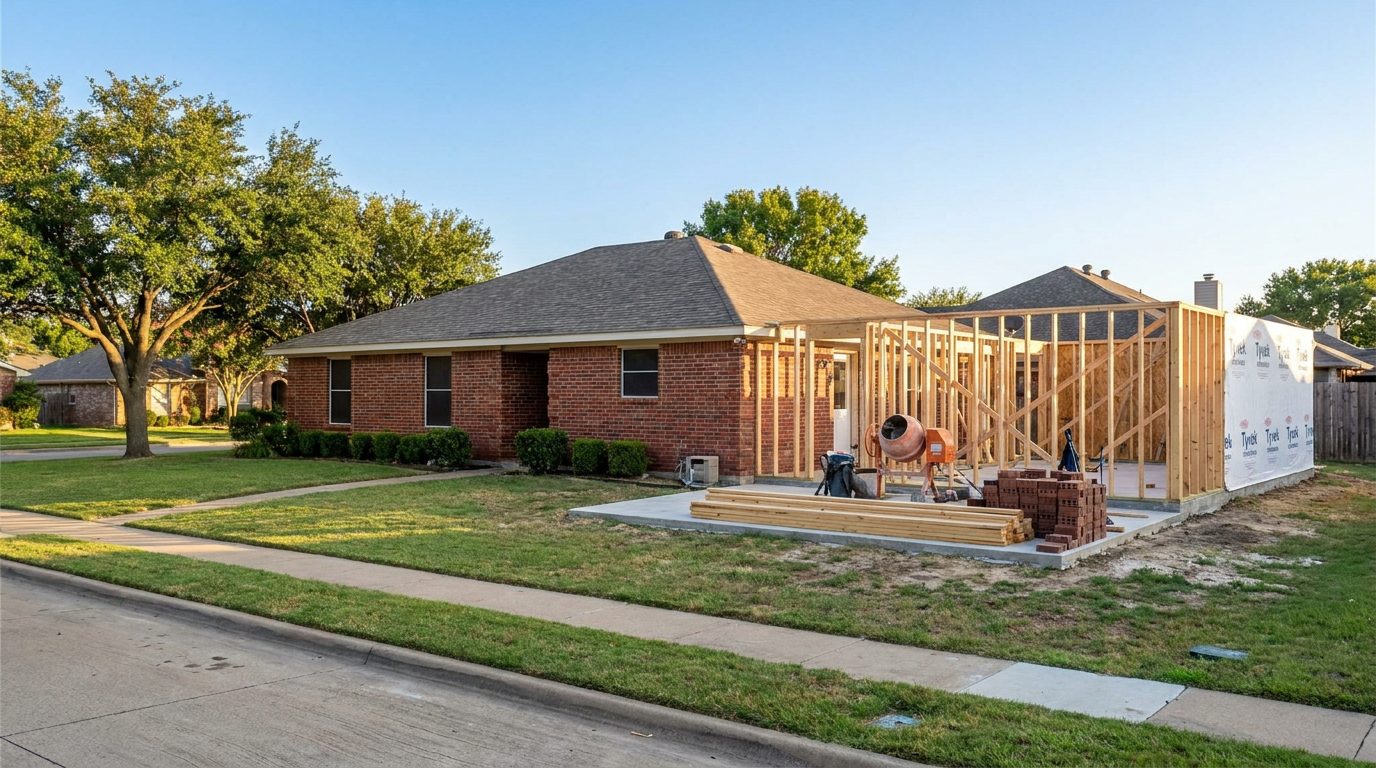
Texas regulates home equity lending more tightly than any other state. The rules live in Article XVI, Section 50(a)(6) of the Texas Constitution, and they apply to home equity loans, HELOCs, and cash-out refinances on your homestead. Lenders cannot waive them.
The 80 Percent Cap
All debt secured by your homestead, the first mortgage plus the new equity loan, cannot exceed 80 percent of the home’s fair market value at closing. Say your Plano home appraises at $450,000 and you owe $300,000. Eighty percent of $450,000 is $360,000, so the most you can borrow against the house is $60,000, even if the lender would happily approve more in another state. This single rule decides more DFW financing plans than any interest rate does.
The 12-Day Waiting Period
Texas requires at least 12 calendar days between your application (with the required disclosure) and closing. No lender can shorten it. You also get a 3-day right to cancel after closing, and funds are not released until that window passes. In practice, plan on 30 to 45 days from application to money in hand, and start the loan process while your contractor is still finalizing drawings rather than after the permit is issued.
The 2 Percent Fee Cap
Lender fees on a Texas home equity loan are capped at 2 percent of the principal, excluding third-party costs such as the appraisal, survey, and title insurance, and excluding discount points. The cap keeps junk fees down, but it also means some national lenders simply do not offer equity products in Texas. Expect a slightly shorter lender list than a Google search implies.
One Equity Loan at a Time
You can have only one Section 50(a)(6) loan against a homestead at once, and after closing one you must wait 12 months before refinancing it into another. If you expect to remodel in phases, a kitchen this year and a bathroom next year, a HELOC’s draw period handles both phases under a single loan, which is usually smarter than two separate closings.
Home Equity Loan vs. HELOC
These two get lumped together, but they behave differently over the course of a remodel.
Home Equity Loan: Fixed and Predictable
A home equity loan pays out the full amount at closing at a fixed rate, averaging 7.35 to 8.10 percent in August 2026, with a level payment over 5 to 30 years. It fits a project with a firm, fixed-price contract: you know the number, you lock the rate, and the payment never moves. The downside is that interest starts on the entire balance from day one, even though your contractor may not need the final draw for months.
HELOC: Flexible While the Project Runs
A HELOC gives you a credit limit and charges interest only on what you have drawn. Average rates sit at 7.16 to 7.50 percent right now, which is unusually close to fixed home equity pricing. The rate is variable, so it moves with the market, and many DFW lenders let you convert drawn balances to a fixed rate later. A HELOC fits phased projects, projects with allowances that may move, and anyone who wants a built-in contingency without paying interest on it.
Side by Side
| Feature | Home equity loan | HELOC |
|---|---|---|
| Average rate (Aug 2026) | 7.35 to 8.10 percent fixed | 7.16 to 7.50 percent variable |
| Payout | Lump sum at closing | Draw as needed, usually 10-year draw period |
| Interest charged on | Full balance from day one | Only the amount drawn |
| Payment | Fixed for the term | Varies with balance and rate |
| Best for | Fixed-bid projects with one payout | Phased work, contingency cushion, uncertain allowances |
| Texas rules apply | Yes, 50(a)(6) | Yes, 50(a)(6) |
Cash-Out Refinance: Do the Math on Your Current Rate
When It Works
A cash-out refinance replaces your whole mortgage with a bigger one and gives you the difference. With 30-year refinance rates averaging 6.85 to 7.09 percent in August 2026 and cash-out pricing running a quarter to half a point above that, this makes sense mainly for homeowners whose existing rate is near or above current rates, often people who bought or refinanced in 2023 through 2025. One loan, one payment, and sometimes a lower blended rate than a second lien.
The Rate Trap
Here is the catch for a large share of DFW homeowners: if you locked a 3 percent mortgage in 2020 or 2021, a cash-out refinance reprices your entire balance at today’s roughly 7 percent. On a $300,000 balance, that is about $12,000 a year in extra interest before you count the remodel money at all. In that situation a home equity loan or HELOC leaves the cheap first mortgage untouched and borrows only the new amount at market rates. This same math is a big part of why so many families remodel instead of moving right now: the addition costs less than giving up the old rate on a new house.
Renovation Loans: Borrowing Against the After-Value
Standard equity products look backward at what the house is worth today. Renovation loans look forward to what it will be worth when the work is done, which is the main route for buyers of fixer-uppers and for owners who have not built much equity yet.
FHA 203(k)
The FHA 203(k) rolls purchase (or refinance) and renovation into one government-backed mortgage with FHA down payment and credit rules. The Limited version covers up to $75,000 of non-structural work under 2026 guidelines. The Standard version has no separate renovation cap beyond FHA county loan limits, covers structural work including additions, and requires a HUD-approved consultant to oversee draws. Work must generally finish within 9 months on the Limited and 12 months on the Standard. Paperwork is heavier than a HELOC, and your contractor must be willing to work on a draw schedule, so raise it early when interviewing contractors.
Fannie Mae HomeStyle and Freddie Mac CHOICERenovation
These conventional cousins of the 203(k) base the loan on the as-completed appraised value, allow nearly any renovation type including luxury items the FHA excludes, and require the work to finish within about 15 months of closing. HomeStyle requires at least a 10 percent contingency reserve on most projects and lender approval of your contractor. For a well-qualified borrower, conventional renovation loans usually price better than FHA once you factor in FHA mortgage insurance.
When a Renovation Loan Beats an Equity Loan
Choose a renovation loan when the 80 percent Texas cap on current value leaves you short, but the after-value supports the budget. A $350,000 house with a $270,000 balance supports only $10,000 of traditional equity borrowing. If a $90,000 room addition takes the appraised value to $450,000, an as-completed loan can fund the whole project.
Construction Loans for Large Additions
For projects north of roughly $150,000, a second-story addition, a detached ADU, or a gut-and-expand whole-home job, some DFW banks and credit unions offer construction or renovation-construction loans. The lender funds the project in draws tied to inspections, you pay interest only on what has been drawn during the build, and at completion the balance converts to a standard mortgage or is refinanced. Rates run about a point above standard mortgage pricing and closing requirements are heavier: full plans, a detailed budget, and a contractor the bank has vetted. The draw-and-inspection structure is genuinely useful on big jobs, since a third party verifies progress before each payment goes out.
How to Finance a Home Addition Without Much Equity
Bought recently in Frisco or McKinney and watched prices flatten? Equity may be thin. You still have workable options.
Personal Loans
Unsecured personal loans run 8 to 36 percent APR, with averages around 12 to 15 percent in August 2026. Funding takes days, there is no appraisal, no lien, and no 12-day Texas wait. The trade is a higher rate and shorter terms, usually 2 to 7 years, so payments are high. They fit projects under about $25,000: a hall bathroom, flooring, or the cosmetic phase of a kitchen.
Zero Percent Intro Credit Cards
For small projects a 0 percent purchase APR card can bridge 12 to 21 months interest free. It only works if you can genuinely clear the balance before the promotional window closes, because the rate afterward is credit card pricing in the 20s. Reasonable for a $8,000 cosmetic refresh, wrong for an addition.
Contractor Financing
Many remodelers, ALC Construction Pros included, can connect clients with lending partners who specialize in home improvement. The convenience is real and approval is fast, but treat it like any other loan: read the rate, the term, and any deferred-interest clause, then compare it against a quote from your own bank or credit union before signing.
FHA Title I
The FHA Title I program insures home improvement loans up to about $25,000 for a single-family home, and loans under $7,500 need no lien at all. Rates are set by participating lenders and the program is easy to overlook, but for a modest, necessary improvement on a home with little equity, it exists for exactly this case.
Texas Veterans: The VLB Home Improvement Loan
The Texas Veterans Land Board runs a home improvement loan program specifically for Texas veterans and military members: up to $50,000, fixed rate, 10 or 20 year terms, for repairs and improvements to an existing primary residence. Loans of $25,000 or less are FHA insured, and veterans with a VA service-connected disability rating of 30 percent or more qualify for a rate discount. Rates are typically below comparable market products. If you served and you are planning an accessibility remodel or any mid-size project, price this program through the Texas General Land Office before anything else.
Comparing All Your Options Side by Side

| Option | Typical rate (Aug 2026) | Typical amount | Secured by home | Best for |
|---|---|---|---|---|
| Home equity loan | 7.35 to 8.10 percent fixed | Up to 80 percent CLTV | Yes | Fixed-bid remodels, $25,000 to $150,000 |
| HELOC | 7.16 to 7.50 percent variable | Up to 80 percent CLTV | Yes | Phased projects and contingency room |
| Cash-out refinance | About 7.1 to 7.6 percent | Up to 80 percent LTV total | Yes | Owners with current rates near 7 percent |
| FHA 203(k) | FHA mortgage rates | Limited: $75,000 reno cap; Standard: FHA county limits | Yes | Fixer-upper purchases, thin equity |
| HomeStyle / CHOICERenovation | Conventional mortgage rates | Based on as-completed value | Yes | Large remodels priced on after-value |
| Construction loan | Roughly 1 point over mortgage rates | Project budget, draw-based | Yes | Additions and builds over $150,000 |
| Personal loan | 8 to 36 percent | $1,000 to $100,000, usually under $50,000 | No | Fast projects under $25,000 |
| VLB veterans loan | Below-market fixed | Up to $50,000 | Yes | Texas veterans, any mid-size improvement |
| Contractor financing | Varies widely | Project amount | Sometimes | Convenience, always compare first |
How Lenders Size You Up
Three numbers drive every approval. Credit score: the advertised averages assume roughly 780 and above; below 680 expect meaningfully higher pricing, and below about 620 most home equity lenders pass. Debt-to-income ratio: lenders want total monthly debts, including the new payment, under about 43 to 50 percent of gross income. Combined loan-to-value: in Texas the 80 percent ceiling is constitutional, and plenty of lenders stop at 75 percent on their own. Pull your numbers before applying, and get quotes from at least three lenders on the same day, since equity pricing varies by a full percentage point between lenders for the same borrower.
Taxes, Appraisals, and Your Property Tax Bill
Two side effects of financing a remodel deserve a paragraph each.
Interest deductibility. Interest on home equity loans, HELOCs, and cash-out proceeds is generally deductible only when the money buys, builds, or substantially improves the home securing the loan, and only if you itemize. A remodel or addition usually qualifies; paying off a truck does not. Keep contracts and receipts, and confirm your situation with a CPA.
Property taxes. A permitted addition becomes new improvement value on your appraisal district’s roll, and new construction is added outside the 10 percent homestead cap in its first year. A $100,000 addition in Dallas County can add roughly $2,000 a year in property tax at typical combined rates. Budget for it, and read our guide on how additions affect property value for the resale side of that equation.
Which Option Fits Your Project?
Under $25,000
A cosmetic kitchen refresh, one bathroom, paint and flooring. Savings first, then a personal loan or 0 percent card if the payoff timeline is realistic, then a small HELOC if you already have one open. The fixed costs of a Texas equity closing are hard to justify at this size unless you will reuse the line later.
$25,000 to $75,000
A full kitchen remodel, a primary bath, a garage conversion. This is HELOC and home equity loan territory: pick fixed if the bid is firm, the line if the scope could move. Veterans should price the VLB loan first at the lower end of this range.
$75,000 and Up
Additions, ADUs, and whole-home renovations. Compare a home equity product against a renovation loan on after-value, and for the largest builds ask about construction financing. If your current mortgage rate is high, run the cash-out refinance numbers too. At this scale a half-point rate difference is real money, so shop hard.
Mistakes DFW Homeowners Make With Remodel Financing
The same handful of errors shows up in projects across Dallas, Plano, Frisco, and Fort Worth. Borrowing before the bid, then discovering the budget is 20 percent short. Giving up a 3 percent first mortgage in a cash-out refinance that a HELOC would have handled. Skipping the contingency, then funding surprises on a credit card at 24 percent. Taking the contractor’s financing without a comparison quote. Starting the loan application after the permit instead of six weeks before, then paying the crew to wait on the 12-day rule. And borrowing against the house for work that does not hold value; our ROI guide covers which projects pay you back.
Frequently Asked Questions
What is the cheapest way to finance a home addition?
For most homeowners with equity, a HELOC or home equity loan at 7 to 8 percent is the cheapest borrowed money in 2026. Cash is cheaper still, and a cash-out refinance can win only if your existing mortgage rate is already near current levels.
How much can I borrow against my home in Texas?
Up to 80 percent of the home’s fair market value minus everything you still owe on it. On a $400,000 home with a $280,000 balance, that is $40,000. The 80 percent cap is in the Texas Constitution and no lender can exceed it.
How long does it take to get a home equity loan in Texas?
Plan on 30 to 45 days. Texas requires a minimum 12 calendar days between application and closing, plus a 3-day cancellation window after closing before funds release, on top of normal underwriting and appraisal time.
Is a HELOC or home equity loan better for a remodel?
A home equity loan fits a fixed-price contract paid in one sum. A HELOC fits phased work and gives you a contingency you only pay for if you draw it. With the two priced within a half point of each other in August 2026, structure matters more than rate.
What credit score do I need to finance a remodel?
Most home equity lenders want 660 to 680 minimum, with the best pricing near 780. Personal loans exist down to the low 600s at much higher rates. FHA 203(k) loans allow scores in the 580s with a larger down payment cushion.
Can I finance a remodel with no equity?
Yes. Renovation loans (203(k), HomeStyle, CHOICERenovation) lend on the home’s after-remodel value, personal loans need no equity at all, and FHA Title I insures improvement loans up to about $25,000 regardless of equity.
Do I need an appraisal for a home equity loan?
Texas requires the lender to establish fair market value, usually with a full appraisal, occasionally with an accepted valuation model on smaller loans. Renovation loans require an as-completed appraisal based on your plans and bid.
Is home improvement loan interest tax deductible?
Interest on equity borrowing is generally deductible when the funds substantially improve the home securing the loan and you itemize deductions. Unsecured personal loan interest is not deductible. Confirm with a tax professional.
Will an addition raise my property taxes in Texas?
Yes. The appraisal district adds permitted new construction to your assessed value outside the homestead cap in its first year. Expect roughly 2 to 2.5 percent of the addition’s appraised value per year at typical DFW combined rates.
Can I have two home equity loans in Texas?
No. Texas allows one Section 50(a)(6) equity loan per homestead at a time, and you must wait 12 months after closing before refinancing it into a new one. A HELOC with a long draw period is the standard workaround for phased remodeling.
What does an FHA 203(k) loan cover?
Almost any permanent improvement: kitchens, baths, roofing, HVAC, structural repairs, and additions on the Standard version. The Limited version caps renovation costs at $75,000 and excludes structural work. Luxury items like pools are excluded on both.
Can I use a renovation loan on a home I already own?
Yes. Both the 203(k) and HomeStyle come in refinance versions that replace your current mortgage and add the renovation budget, underwritten on the after-completion value.
How do construction loan draws work?
The lender releases money in stages tied to completed work, usually after an inspection at each milestone: foundation, framing, dry-in, finish. You pay interest only on released funds during the build, then the loan converts or refinances into a mortgage.
Do remodeling contractors offer financing in Dallas?
Many do, through third-party lending partners. It can be convenient and quick, and it is worth hearing the terms. Just compare the offer against your own bank or credit union before you sign, exactly as you would compare bids.
What special financing do Texas veterans get?
The Texas Veterans Land Board home improvement loan: up to $50,000 at a fixed below-market rate over 10 or 20 years, FHA-insured at $25,000 or less, with an additional rate discount for veterans rated 30 percent or more disabled by the VA.
Should I wait for rates to drop before remodeling?
HELOC rates hit a 2026 low of 7.16 percent in August, and construction costs in DFW have risen most years regardless of rates. If the project pays for itself in daily use, financing now with a variable-rate line, or refinancing a fixed loan later, usually beats waiting while bids climb.
Can I pay for a remodel in installments to the contractor?
Reputable remodelers work on a payment schedule tied to milestones, but that schedule tracks the work, it is not financing. You still need the funds available as each phase completes. Texas homeowners should be wary of any contractor asking for most of the money up front.
How much should a down payment on a remodel be?
A reasonable deposit in Texas is typically 10 to 30 percent depending on custom materials that must be ordered. Combined with milestone payments, you should never be paying far ahead of completed work, whatever loan is behind the payments.
Does financing change how much house I can remodel?
It sets the ceiling. The Texas 80 percent cap plus your mortgage balance defines your equity budget; an as-completed renovation loan can raise that ceiling when the project itself adds enough value. That is why scoping and financing conversations should happen together.
How much does a home addition cost in Dallas-Fort Worth?
Most room additions run $150 to $275 per square foot finished, so a 400-square-foot addition lands between $60,000 and $110,000. City-specific guides for McKinney and the broader DFW market break down the drivers.
Can I finance an ADU or garage conversion the same way?
Yes. ADUs and garage conversions use the same tools, and because a detached ADU can add substantial appraised value, as-completed renovation loans and construction loans work particularly well for them. Our Dallas ADU guide covers the zoning side.
Plan the Project Before the Loan
Every financing decision above gets easier once you know the real number for your project. ALC Construction Pros has remodeled kitchens, bathrooms, and whole homes across Dallas-Fort Worth since 2014, and a detailed written estimate from our team gives you exactly what a lender wants to see: scope, price, and timeline on paper. Request a free estimate, browse completed projects, or find your city on our service areas page. We are happy to walk through how other homeowners in your neighborhood structured both the project and the payment for it.




