
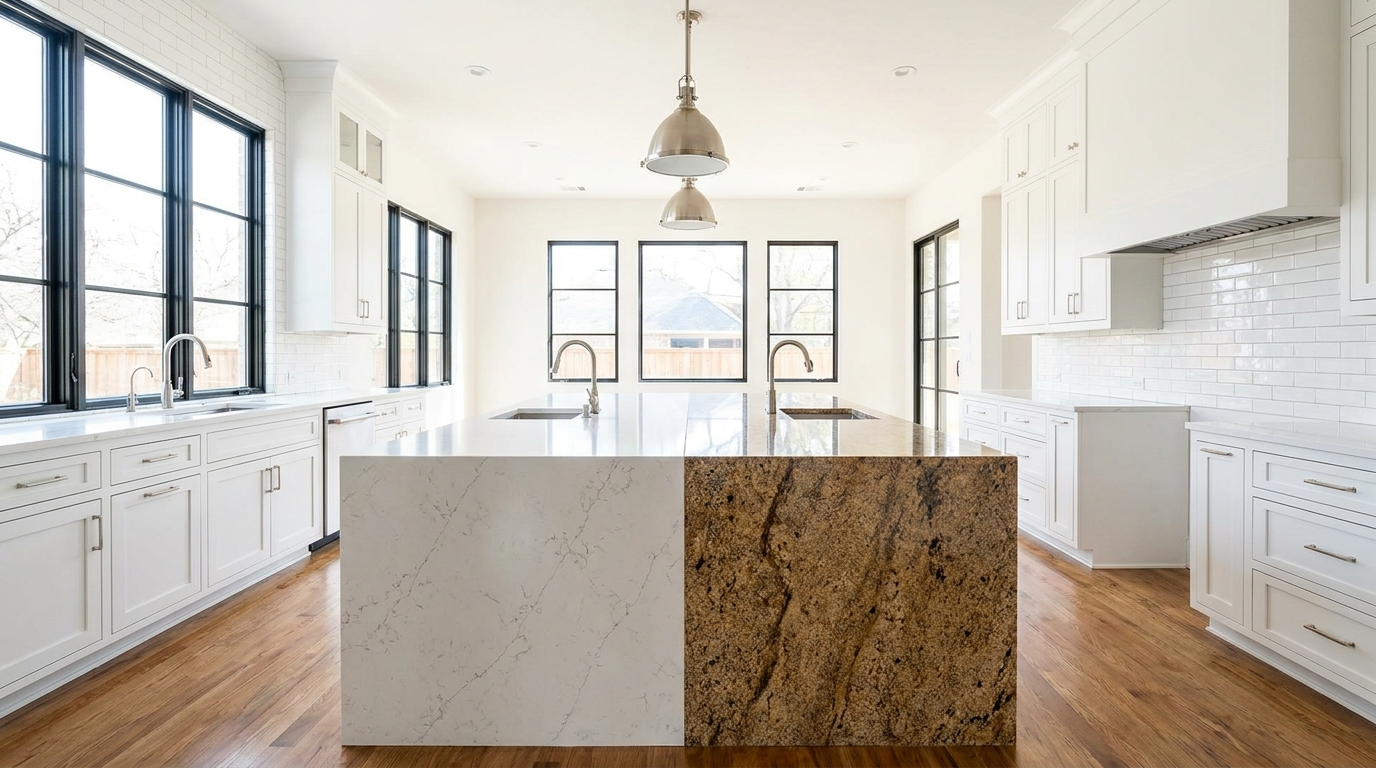
Quartz wins for low upkeep and a consistent look, while granite wins for heat resistance and natural, one-of-a-kind character. In Dallas Fort Worth kitchens, installed quartz runs about $60 to $120 per square foot and granite about $45 to $100. Pick quartz for busy family kitchens and white, marble-style looks. Pick granite if you cook a lot or want the lowest upfront price.
Quartz vs. Granite: Cost, Maintenance, and Durability
Cost: Installed quartz runs $60 to $120 per square foot and granite $45 to $100, so a typical 40 square foot kitchen lands around $2,400 to $4,800 for quartz and $1,800 to $4,000 for granite.
Maintenance: Quartz is non-porous and never needs sealing, while granite is slightly porous and should be resealed every one to two years.
Durability and heat: Granite handles a hot pan straight off the burner and resists scratches best, while quartz resists stains best but can scorch above about 300 degrees, so keep trivets nearby.
What Affects Countertop Cost in DFW?
Material and grade: Entry, mid, and premium tiers each move the price, and a designer quartz can cost as much as a high-end granite.
Square footage and layout: Larger runs, an island, and extra cutouts for a farmhouse or prep sink all add to the total.
Edge profile and thickness: A thicker slab, waterfall edges, and premium edges like ogee or mitered raise the price over a standard profile.
Fabrication and installation: Local fabrication, seam placement, and removing and disposing of the old countertop all factor into the installed cost.
The final cost of a DFW countertop project depends on the material and grade you choose, the square footage and layout of your kitchen, the edge profile and slab thickness, and the fabrication and installation your job requires.
Quartz vs. Granite at a Glance
Most homeowners we meet in Plano, Frisco, and Dallas have already narrowed their countertop choice to these two. They both look great, both last for decades, and both sit in a similar price range. The differences that actually matter show up in daily use: how much maintenance you want to do, how hard you cook, and whether you want a predictable pattern or a natural slab where no two pieces match. Here is the short version before we get into the details.
| Factor | Quartz | Granite |
|---|---|---|
| Installed cost (DFW, 2026) | $60 to $120 per sq ft | $45 to $100 per sq ft |
| Sealing | Never needs sealing | Reseal every 1 to 2 years |
| Heat resistance | Up to about 300°F, use trivets | Up to about 1,200°F |
| Stain resistance | Excellent, non-porous | Good once sealed |
| Scratch resistance | Very good | Excellent |
| Appearance | Uniform, consistent color | Natural, unique per slab |
| Pattern control | Predictable, easy to match | Every slab is different |
| Direct sunlight | Can fade over years | Holds color, fine outdoors |
| Best for | Family kitchens, marble looks | Heavy cooks, tighter budgets |
Neither material is a mistake. The right answer depends on your household, not on which one is objectively “better.” Anyone planning a full renovation should read our Dallas kitchen remodel cost guide alongside this page, since countertops are usually the second or third largest line item after cabinets.
Cost Comparison: What Countertops Actually Run in DFW
National averages get quoted a lot, but they rarely match what a Dallas Fort Worth fabricator will charge. The metroplex has a deep bench of stone yards and installers, which keeps pricing competitive. Granite still tends to start lower because a granite slab is quarried and cut, while quartz is manufactured, and that process adds cost at the entry level. At the premium end the two converge, and a designer quartz can cost as much as a high-end granite. Here is the range we see on real DFW jobs in 2026.
| Tier | Quartz (installed) | Granite (installed) |
|---|---|---|
| Entry / builder grade | $60 to $75 per sq ft | $45 to $60 per sq ft |
| Mid grade | $75 to $95 per sq ft | $60 to $80 per sq ft |
| Premium / designer | $95 to $120+ per sq ft | $80 to $100+ per sq ft |
| Typical 40 sq ft kitchen | $2,400 to $4,800 | $1,800 to $4,000 |
Those numbers include the slab, fabrication, and standard installation. A few things push the total higher for both materials: a thicker profile, waterfall edges, extra cutouts for a farmhouse sink or a second prep sink, and premium edge profiles like ogee or mitered. Removing and disposing of an old countertop adds a bit as well. If your budget is tight, granite in the entry to mid tier is usually the cheaper path to a stone counter, which is one reason it stays popular in value-range homes across Garland, Irving, and Arlington.
Durability and Maintenance
Both surfaces will outlast most other parts of your kitchen, so durability is less about which one survives and more about how much attention it asks for. This is where quartz has a real edge for busy households.
Quartz is non-porous. It never needs sealing, it does not harbor bacteria in the surface, and a wipe with mild soap and water handles almost everything. Red wine, coffee, lemon juice, and tomato sauce sit on top rather than soaking in, so a busy family with kids rarely has to think about it. That low-maintenance quality is the single most common reason our clients choose it.
Granite is a natural stone, so it is slightly porous and needs to be sealed. A good fabricator seals it at installation, and after that you reseal roughly once every one to two years, depending on the stone and how hard you use it. The test is simple: drip a little water on the surface, and if it beads up the seal is good, if it darkens and soaks in it is time to reseal. Resealing takes about twenty minutes and costs almost nothing. Skip it for years and a light granite can pick up an oil stain near the cooktop. Keep up with it and granite performs beautifully for decades.
Heat, Scratch, and Stain Resistance
If you cook the way a lot of Texans do, this section decides the whole thing. Granite is one of the most heat-tolerant countertop materials made. It handles direct contact from a hot pan or a cast-iron skillet straight off the burner, tolerating temperatures well above a thousand degrees. Set a Dutch oven down while you plate dinner and the granite does not care.
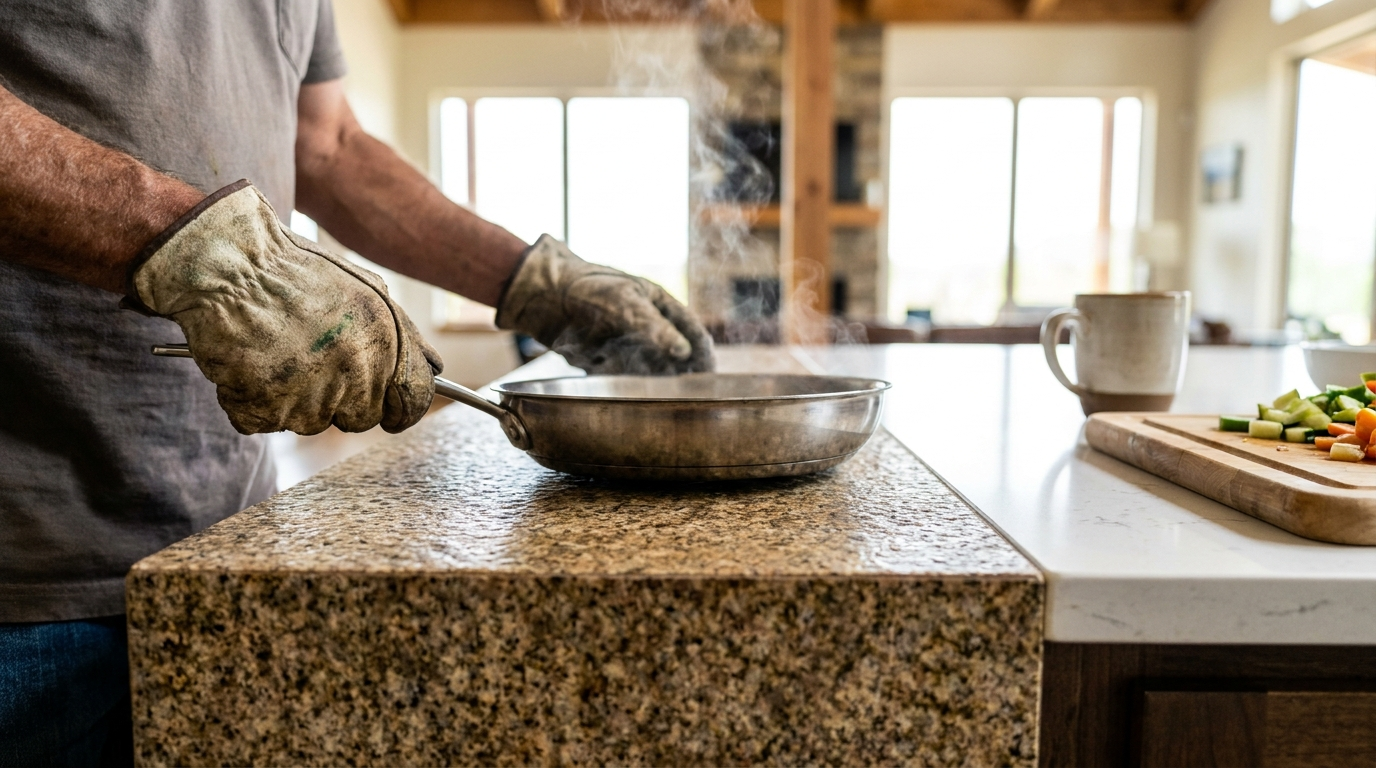
Quartz is more sensitive to heat because roughly ten percent of the slab is a resin binder that holds the ground stone together. Sustained heat above about 300 degrees can scorch or discolor that resin, and the mark is permanent. It is not fragile, and a warm plate will not hurt it, but a screaming-hot pan set directly on the surface can leave a burn ring. If you go with quartz, keep a couple of trivets near the range and the problem never comes up.
On scratches, granite is slightly harder and shrugs off knife contact, though you should still use a cutting board on either surface to protect your knives. On stains, quartz pulls ahead because it is non-porous, while granite resists stains well as long as the seal is current. So the resistance question splits cleanly: granite for heat and scratches, quartz for stains and spills.
Look, Style, and Resale Value
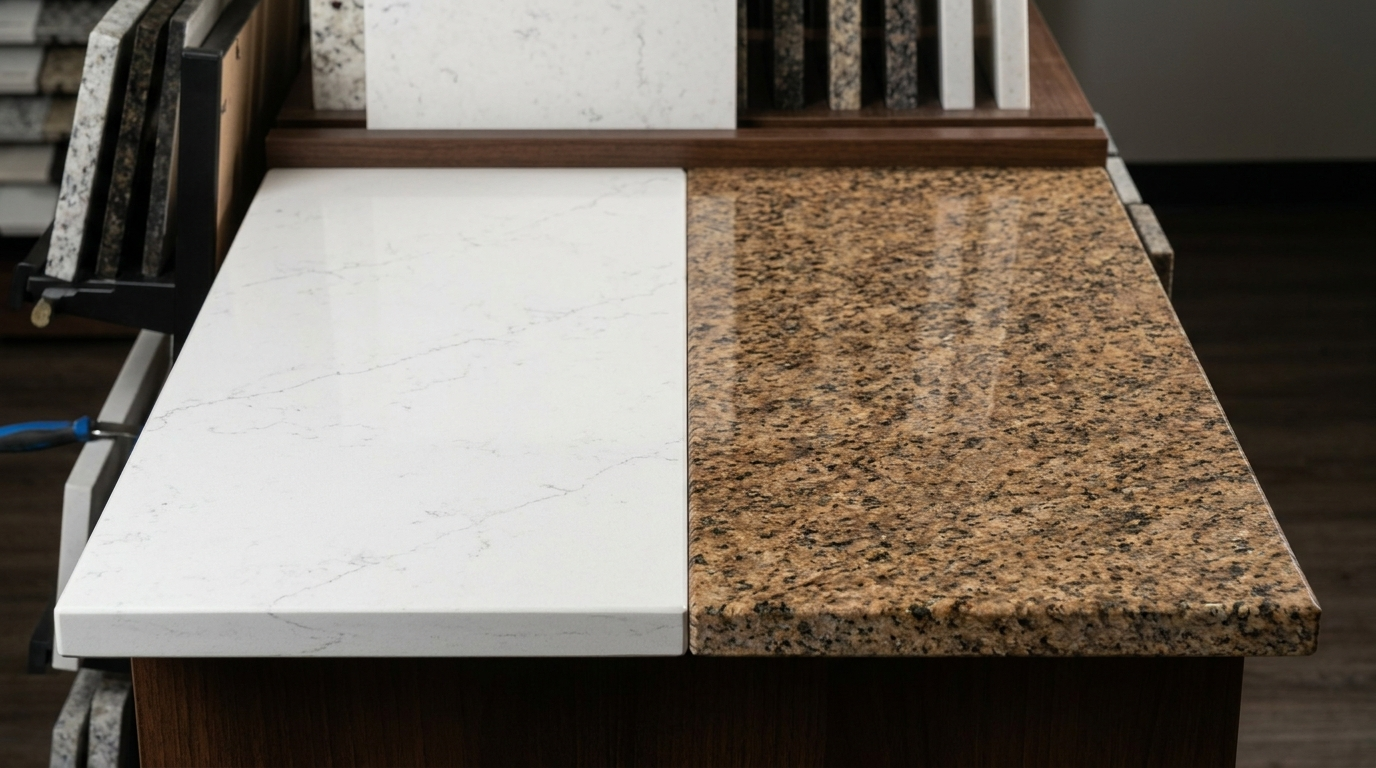
Appearance is where personal taste takes over. Quartz gives you a controlled, consistent look. If you want the soft veining of Carrara marble without marble’s fragility, quartz from brands like Cambria, Caesarstone, and Silestone nails that appearance and stays low maintenance. Because the color is uniform, what you see on the sample is what lands in your kitchen, which makes it easy to match across an island and perimeter runs.
Granite gives you natural movement, depth, and color that a manufactured product cannot copy. Every slab is unique, with grains, flecks, and rivers of mineral that make the counter feel like a piece of the earth. The tradeoff is that you have to shop the actual slab. Two pieces labeled the same color can look noticeably different, so go to the yard, tag your slab, and see it under real light before it gets cut.
For resale in the DFW market, updated stone countertops help either way, and buyers rarely reject a home over which one you chose. In higher-end neighborhoods like University Park, Highland Park, and Preston Hollow, quartz tends to read as the current, low-maintenance choice buyers expect, which is worth keeping in mind if you are remodeling to sell. Our Preston Hollow kitchen remodel guide digs into what those buyers look for. In value-range and mid-market homes, granite’s lower cost often delivers comparable return because you spend less to get the same “this kitchen is updated” signal. Either way, a fresh countertop is one of the upgrades that helps a kitchen show well, which is part of why it appears in our Dallas kitchen remodel ideas roundup.
Best Pick by Household Type
Instead of naming a single winner, match the material to how you live. Here is the framework we walk clients through during a countertop selection consult.
| Your situation | Better pick | Why |
|---|---|---|
| Busy family with young kids | Quartz | No sealing, shrugs off spills and juice |
| Serious home cook | Granite | Handles hot pans without trivets |
| Tightest budget for real stone | Granite (entry tier) | Lowest installed price per sq ft |
| Want a white or marble look | Quartz | Consistent veining, stays low maintenance |
| Remodeling to sell in a $450K+ home | Quartz | Matches current buyer expectations |
| Outdoor kitchen or patio bar | Granite | Will not fade in Texas sun |
| Hate maintenance of any kind | Quartz | Wipe and go, no resealing |
| Love natural, one-of-a-kind stone | Granite | No two slabs are alike |
What DFW Fabricators Recommend
A few points come up again and again when we talk with the stone yards and fabricators we work with across the metroplex. First, buy the slab, not the sample chip, especially for granite. The chip shows color, not movement, and a slab can surprise you. Second, ask where the fabrication happens. A local shop with its own templating and CNC equipment usually gives you a cleaner seam placement and a better edge than a big-box package that subcontracts the work. Third, plan seams before you fall in love with a layout. A long island or an L-shaped run may need a seam, and a good fabricator will place it where it is least visible rather than where it is easiest to cut.
On the outdoor question, Texas sun matters. Some quartz colors can fade or yellow with years of direct UV exposure, so most fabricators steer you to granite or quartzite for an outdoor kitchen or a sunroom with big south-facing windows. Indoors, either one is fine. And if you are weighing quartzite, know that it is a natural stone closer to granite in behavior, not the same thing as manufactured quartz, even though the names sound alike.
How Countertops Fit the Rest of Your Kitchen Budget
Countertops rarely get chosen in isolation. They sit on top of your cabinets, so the two decisions interact. If you are keeping good boxes and refreshing the look, our guide to painting kitchen cabinets in Dallas pairs well with a new counter for a mid-range refresh. If you are gutting the space, the counter is one milestone in a longer sequence, and templating cannot happen until the cabinets are set and level. That is why countertop lead time is baked into the schedule we lay out in our kitchen remodel timeline guide. Expect one to three weeks between templating and installation for most stone, since the slab has to be fabricated to your exact measurements.
Local pricing shifts a little by city. Homeowners comparing quotes in Plano can see how counters fold into a full project in our Plano kitchen remodel cost breakdown. Wherever you are in Dallas Fort Worth, the countertop choice is a good moment to sit down with a contractor who can price the whole kitchen, not just the stone, so you know the tradeoffs before you commit. Our kitchen remodeling team handles design, cabinets, counters, and installation as one project.
Frequently Asked Questions
Is quartz or granite more expensive?
At the entry level, granite is usually cheaper because it is quarried and cut, while quartz is manufactured and that adds cost. In DFW, installed granite starts around $45 per square foot and quartz around $60. At the premium tier the two converge, and a designer quartz can cost as much as high-end granite.
Which lasts longer, quartz or granite?
Both last for decades and typically outlive other kitchen finishes. Granite can be re-polished and resealed if it dulls over many years, while quartz keeps its finish without any upkeep. Neither one is likely to be the reason you remodel again.
Does quartz or granite add more resale value in Dallas Fort Worth?
Both help a kitchen show as updated, which is what buyers respond to. In higher-end DFW neighborhoods, quartz often matches current buyer expectations for low maintenance. In mid-market homes, granite can deliver similar return at a lower upfront cost, so the value edge depends on your price point.
Can you put a hot pan on quartz?
Not directly. Sustained heat above about 300 degrees can scorch the resin in quartz and leave a permanent mark. Use a trivet or a hot pad for pots and pans coming off the burner. A warm plate is fine.
Can you put a hot pan on granite?
Yes. Granite tolerates very high heat and handles a hot pan straight off the stove without damage. It is one of the most heat-resistant countertop materials available, which is why heavy cooks tend to prefer it.
Does granite need to be sealed?
Yes. Granite is slightly porous, so it should be sealed at installation and resealed about every one to two years. The test is easy: if water beads on the surface the seal is good, and if it soaks in and darkens the stone it is time to reseal. The job takes minutes.
Does quartz need to be sealed?
No. Quartz is non-porous and never needs sealing. Cleaning with mild soap and water is all it asks for, which is a big part of its appeal for busy households.
Which is easier to clean?
Quartz, slightly. Because it is non-porous, spills wipe away without any risk of soaking in, and there is no sealer to maintain. Granite cleans easily too, but a current seal is what keeps it stain-free.
Does quartz stain?
Rarely. Quartz resists stains from wine, coffee, and citrus because liquids cannot penetrate the surface. Wipe spills in a reasonable time and you will not see a mark. Harsh chemicals and abrasive pads are the things to avoid.
Can granite crack?
It can, but it is uncommon in normal use. Granite is very hard and stable once installed. Cracks usually trace back to a poorly supported overhang, an unsupported seam, or damage during handling, which is why professional templating and installation matter.
Does quartz fade in sunlight?
Some quartz colors can fade or yellow after years of direct UV exposure, which is why it is not the first choice for outdoor kitchens or sun-drenched rooms in Texas. Indoors, away from constant direct sun, fading is not a practical concern.
Is granite outdated in 2026?
No. Quartz has taken a lot of market share, but granite is still widely specified, especially in value-range homes and for cooks who want its heat resistance. Current granite selections lean toward cleaner, less busy patterns than the speckled looks common a decade ago.
Which is better for a white kitchen?
Quartz, most of the time. It offers consistent white and marble-look patterns that pair cleanly with white or light cabinets. White granite exists, but its natural variation makes an exact, uniform look harder to guarantee across the kitchen.
Can you cut directly on quartz or granite?
You can without damaging the stone, but you should not, because both surfaces will dull your knives fast. Use a cutting board on either material to protect the blades.
Does granite give off radon?
The amount is negligible. The EPA notes that radon from granite countertops is generally far below levels of concern in a normal home. If it worries you, a simple home radon test covers the whole house, not just the counter.
Which is more scratch resistant?
Granite is slightly harder and edges out quartz on scratch resistance, though both handle daily use well. Quartz is still very scratch resistant. In practice, a cutting board makes the difference moot for either surface.
How thick should a countertop be?
Most kitchens use a 3 centimeter slab, roughly 1.25 inches, for both quartz and granite. It is strong enough for overhangs and looks substantial. A 2 centimeter slab costs less but often needs a plywood substrate or a built-up edge to look and perform right.
How long does countertop installation take?
The actual install is usually a single day. The wait is between templating and installation, which runs about one to three weeks while the slab is fabricated to your measurements. Templating cannot happen until the cabinets are set and level.
Is quartz or granite better for bathrooms?
Quartz is a favorite for bathroom vanities because it is non-porous and shrugs off toothpaste, makeup, and water without sealing. Granite works well too. If you are remodeling a bath, our Dallas bathroom remodeling team can spec the right surface for the room.
Which is more environmentally friendly?
It is a wash with tradeoffs. Granite is natural but quarried and shipped, which carries a transport footprint. Quartz is manufactured, sometimes with recycled content, but the process uses energy and resin. Choosing a local fabricator and a durable slab you will keep for decades is the greener move for either one.
Can quartz or granite be repaired?
Granite is easier to repair. Chips can be filled and the surface re-polished or resealed. Quartz is harder to fix because a burn or deep scratch in the resin is usually permanent, though minor chips can sometimes be patched by a pro. Prevention beats repair on both.
How do I choose between quartz and granite?
Start with how you cook and how much upkeep you want. If you set hot pans down constantly or want the lowest price on real stone, go granite. If you want zero maintenance and a consistent white or marble look, go quartz. When it is still close, see the actual slabs in person and let the one you love win.
Ready to Choose Your Countertop?
The best way to settle quartz vs granite is to see the slabs next to your cabinets and finishes, with a real price for the whole kitchen in front of you. ALC Construction Pros has remodeled kitchens across Dallas, Plano, Frisco, McKinney, Allen, and Fort Worth since 2014, and we handle design, cabinets, counters, and installation as one coordinated project. Browse a few completed remodels to see how different counters read in finished spaces, then request a free countertop selection consult. We will help you weigh the tradeoffs and price the full project, not just the stone.




